A “Nine-Colored Deer Jataka” Sprawling Across Skyscrapers — Reimagining a Dunhuang Mural as Urban Space
2026.02.23投稿
広告
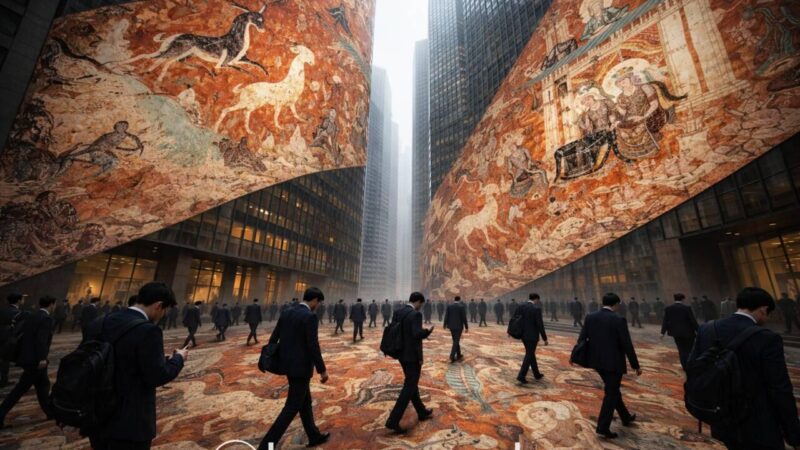
In a canyon of glass-and-steel towers, a tide of suited workers moves forward with blank faces—while an ancient mural juts out like a colossal “banner.”
In that instant, the piece announces not mere “viewing,” but a hostile takeover of the environment itself.
The same painted surface even spreads across the pavement underfoot, and we are made to walk on top of the story.
1. First Impressions: An Exposed Wound in the City
My first impression is of an “urban wound” where layers of time have peeled back and raw history is exposed.
The straight lines of glass and iron are bitten into by earthen reds, flaking surfaces, soot, and the gritty texture of mineral pigments.
Your gaze is pulled upward—only to be yanked back down a moment later by the image stamped onto the ground.
Within the imagery, running animals and a palace scene unfold in parallel, as if panels of a moral fable have been enlarged to wrap the entire city.
Yet the crowd sinks into their smartphones, moving as though deliberately averting their eyes from the mural’s “lesson.”
That muted contrast is both the poison and the honey of this work.
2. Identifying the Source Masterpiece: What It Refers To
The most plausible source is the narrative mural known as the “Nine-Colored Deer Jataka” in Mogao Cave 257 (Northern Wei period) at Dunhuang.
The “running deer (with legs exaggerated almost like horses),” the “king and queen seated close together in a palace,” and the implied hunting pursuit align strongly with that mural’s continuous narrative format.
In particular, the sequence—“palace scene → betrayal/reporting → hunting → confrontation”—matches explanations of the Nine-Colored Deer Jataka on the west wall of Cave 257, where the story converges toward the center from both sides.
(Sources:
Digital Dunhuang (Mogao Grottoes Cave 257),
Taito City Calligraphy Museum Virtual Museum (Dunhuang Mogao Cave 257 / Nine-Colored Deer))
Work Data (Original Reference)
Title: “Nine-Colored Deer Jataka” (part of the narrative paintings on the west wall of Mogao Cave 257).
Artist: Unknown (likely produced by workshop painters in Dunhuang).
Date: Northern Wei period (historically 386–534 CE; Cave 257 is generally dated to this era).
Location: Mogao Grottoes, Dunhuang, Gansu Province, People’s Republic of China.
(Source:
Digital Dunhuang (Cave 257 / Northern Wei))
Historical Background: Dunhuang, Mogao, and “Jataka” Stories
The Mogao Grottoes were created at a key crossroads of the Silk Road, where Buddhist art accumulated over centuries amid multilingual, multicultural exchange.
They were inscribed as a UNESCO World Heritage site in 1987, with the murals and sculptures protected as an integrated whole.
(Source:
UNESCO World Heritage Centre (Mogao Caves))
A Jataka is a Buddhist “birth story”—a tale of the Buddha’s previous lives that dramatizes moral virtues and cause-and-effect (karma). These murals functioned as a visual device to embed ethics into memory.
In the Nine-Colored Deer story, a deer saves a drowning man; the man betrays the deer by reporting its whereabouts for personal gain, leading to the deer’s confrontation with royal power and the logic of retribution.
(Sources:
Digital Dunhuang (Cave 257 / West Wall),
Taito City Calligraphy Museum Virtual Museum (Story Summary))
Key Formal Traits: Composition, Style, and Narrative Rhythm
The narrative painting in Cave 257 runs like a banded “strip,” treating the surface as a continuous sequence, with the story converging toward the center from both ends.
Architecture is rendered conceptually rather than through realistic perspective, and figures stand out through strong outlines and economical shading.
Scholars often note continuities with Central Asian mural traditions (such as those at Kizil).
(Sources:
Digital Dunhuang (Narrative structure notes),
Taito City Calligraphy Museum Virtual Museum (Commentary))
3. What the Reinterpretation Changes (and Why It Works)
Scale as a Weapon: From Cave Wall to Urban Facade
The original’s immersive power—meant for a cave interior—is transplanted onto the exterior skin of skyscrapers.
And it doesn’t stop at one wall: it spans both sides of the street, turning the entire canyon into a monumental picture-scroll.
The mural is no longer “background”; it becomes the city’s dominant sign.
The Pavement Transfer: Turning Viewers into Participants
Once the same imagery is laid across the ground, the viewer loses any safe distance.
To walk on top of the story converts themes of good/evil and karmic consequence into bodily sensation.
That coercive intimacy is the reinterpretation’s most aggressive—and most contemporary—move.
Replacing the “Center”: From King & Queen to the Suit-Wearing Crowd
In the original, power concentrates around a ruler in the palace. Here, it dissolves into an uncountable mass of office workers.
Desire and betrayal are no longer framed as “one person’s evil,” but as an atmosphere absorbed into ordinary systems—performance reviews, career incentives, conformity pressure.
By that substitution, the Nine-Colored Deer becomes less a religious tale and more a parable of urban ethics.
4. Interpretation: What Does This Work Accuse—and What Might It Save?
The Nine-Colored Deer story is a short-circuited fable of social darkness: gratitude, a pact of silence, betrayal, the intrusion of power, and the return of consequences.
By pasting it onto an office district, the motive for betrayal shifts naturally—from a literal reward—to status, advancement, and the quiet violence of belonging.
The larger the mural becomes, the smaller the crowd appears, and the more brutally that shift lands.
Here is the critical point from a connoisseur’s angle: the “flaked surface” is not just vintage styling—it reads as a symbol of memory itself wearing down.
We may know moral stories, yet still be able to trample them every morning on the way to work.
The artist forces that contradiction into the city’s flooring, until it becomes inescapable.
5. Closing Appraisal (as a Connoisseur—and a Student of Fakes)
Overall, this reinterpretation succeeds in dragging the Nine-Colored Deer out of “a picture of righteousness” and into “a place where righteousness gets consumed.”
The iconography is chosen with precision: the sprinting animals and the palace intimacy sit side by side, letting you read ignition points of desire and the kinetic force of violence within a single field.
Then, by turning the image into pavement, appreciation mutates into an ethical ordeal—almost a modern “trial by stepping.”
If I praise it from the perspective of someone who studies how images can be forged, it’s this: the powdery grain of ancient pigment and the layered, sooty reds are preserved rather than flattened into digital cleanliness.
Make it too pristine and it becomes a lie; overdo the grime and it becomes theater.
This piece holds its footing at that dangerous boundary—barely, but convincingly.
References
- Digital Dunhuang (Mogao Grottoes Cave 257 / Nine-Colored Deer Jataka)
- UNESCO World Heritage Centre: “Mogao Caves”
- Smarthistory: “Mogao caves at Dunhuang”
- Taito City Calligraphy Museum Virtual Museum (Dunhuang Mogao Cave 257 / Nine-Colored Deer)
- Taito City Calligraphy Museum Virtual Museum (Commentary on the Jataka mural)